
About the book
The hidden architecture beneath every business email.
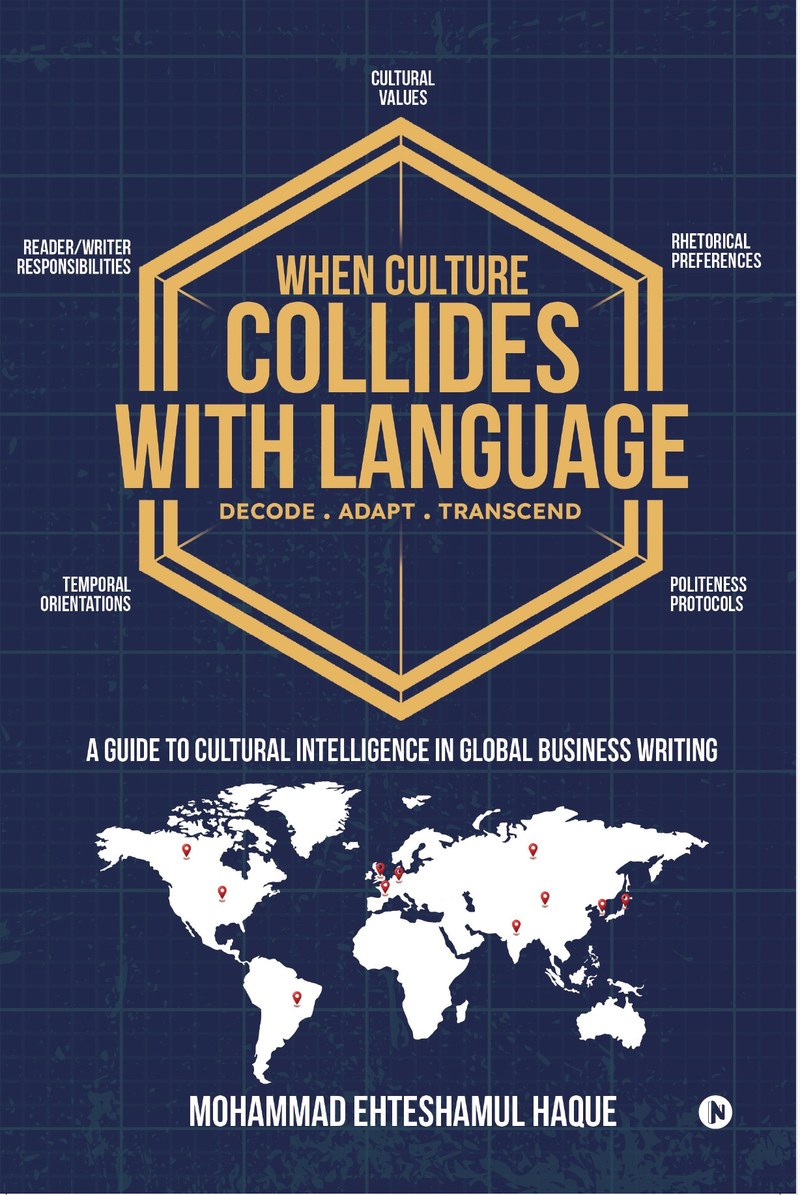
When Culture Collides with Language is a practitioner's guide to cultural intelligence in global business writing. It maps why messages that read fluently in one capital land badly in another, and what to do about it before the next email goes out.
The book is structured in two parts. Part I explains the hidden architecture of business communication across cultures: seven framework chapters. Part II applies the framework country by country, twelve playbooks for the markets most managers actually write into.
The idea came during the pandemic, when travel stopped and corridor conversations and dinners no longer solved the problems they used to. The work moved entirely onto the page. Five years of research and writing later, the manuscript arrived. Every example comes from real meetings, real emails, and real misunderstandings. Nothing here is theory for theory's sake.
Who it is for
Practitioners, not academics.
If you run a team across two continents, write a Tuesday-morning email that has to land in five capitals, or sit in a negotiation where everyone speaks English but nobody seems to mean the same thing, this book is for you.
It is also for L&D and HR leaders trying to build cultural intelligence into the writing their teams do every day, and for senior managers preparing for a regional or global role.
It is not for readers looking for theory in isolation. The frameworks here are tools. They earn their place when they save a meeting, repair a fraying relationship, or land a decision that matters.
Part I · The framework
Seven chapters that explain how cultures build written meaning.
Each chapter is published as its own page on the site, with the worked examples and graphics from the book. Read in order, or jump to the one that matches the message in front of you.
Why perfect emails fail across cultures. The architecture beneath every business document.
A calibration instrument for any reader, any context. Twelve dials, four clusters, one adaptive document.
Whose job it is to make the meaning land. Three doorways into the same document.
How a request gets phrased, how a refusal sounds, and whose face gets protected. Seven linguistic dials and four cultural clusters.
Where the point goes, how evidence stacks, why the same data lands differently. Six rhetorical levers.
Clock time or event time. Why your Monday email gets a Thursday reply, and what to do about it.
The protocols that turn distance into deliberate collaboration. Six challenges, six fixes.
Part II · The countries
Twelve countries. Twelve playbooks.
The framework applied country by country. Each chapter walks through how the five dimensions land in one national business culture, with worked email, meeting, and negotiation examples drawn from real practice.
Where informality meets intensity. First names from day one, and a relentless drive for the bottom line.
Where tradition meets global pragmatism. Understatement does the work, and the real meaning sits between the lines.
Where courtesy meets clarity. Polite on the surface, precise in the substance, and quietly bilingual at the seams.
Where precision meets principle. Direct, structured, and deeply uncomfortable with ambiguity. Process is care.
Where logic meets l'art de vivre. Rigorous reasoning carried with style, and an argument is not the same as a fight.
Where Byzantine complexity meets brutal candour. Hierarchy is taken seriously, and so is plain speaking.
Where harmony conceals hierarchy. Face is preserved through indirection, and the real decision happens before the meeting.
Where precision meets ambiguity. Silence carries information, and the gap between the formal and the real is doctrine, not failure.
Where hierarchy meets velocity. Status is read in seconds, and decisions land at speeds that surprise outsiders.
Where ancient wisdom meets digital innovation. A high-context culture writing in English at global pace, with relationships running underneath every line.
Where hierarchy dances with warmth. Personal trust is the only trust that travels, and the meeting before the meeting is where the work gets done.
Where elegance meets pragmatism. Style carries substance, and the personal relationship is not a preliminary, it is the deal.
With a foreword by Professor Parvaiz Talib, Former Dean and Chairman, Faculty of Management Studies, Aligarh Muslim University.
Locating the closest retailer…